Dear all,
As part of our outreach for “Mothering – Subversive Fürsorge als radikale Praxis”, Epona Hamdan, Dr. Carolina Tamayo Rojas and I will be giving a writing workshop at the Haus der Kunst in Munich on Oct 3 (14:00-18:00). Mothering und das Nichtmenschliche // Mothering and the more-than-human. A poetic writing session on Atmosphere, Time and the Unseen. The main language of the workshop will be German, with options to work with English and Spanish. The workshop is tied not just to notions of interdependent mothering that we explore in our anthology but also to the current exhibition at HDK Tomás Saraceno in collaboration. Ancestral Futures. We are excited to incorporate the exhibition as part of the workshop and to be working with excerpts from the following texts:
- How to Mend: Motherhood and Its Ghost, Iman Mersal
- Vom Nutzen unseres Ärgers, Audre Lorde
- Maternidades Subversivas, Maria Llopis
- Täuschung, Adania Shibli
We are also participants in this workshop in many ways and are eager to immerse ourselves in this time with you. Please share with friends in Munich and surroundings 🙂
Details auf Deutsch. Details in English.
Warmly,
Caro, Epona, Aadhi.
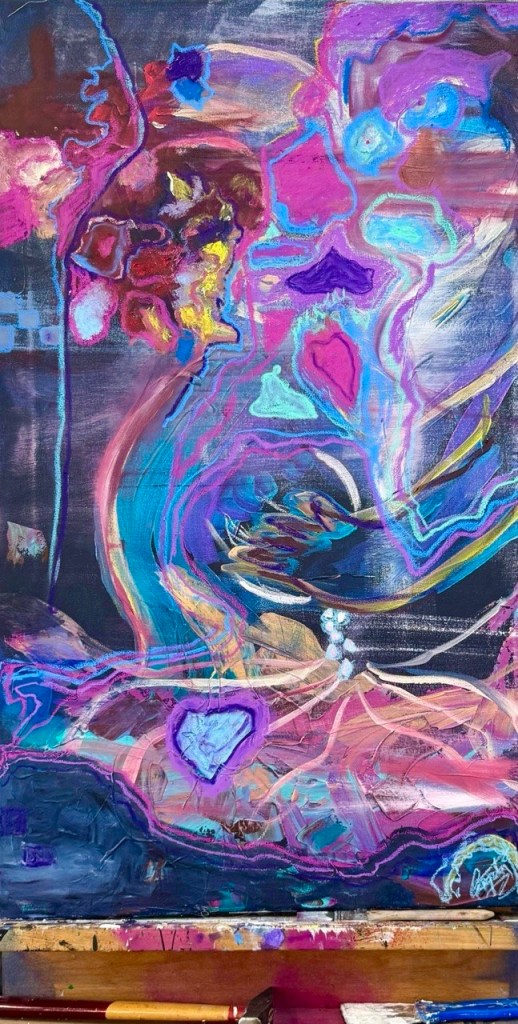
Name of painting: “temas”
Artist: Çağdaş Çelik El Kadi
Participation
Free, limited number of participants, please register via e-mail
Info
Mothering and the more-than-human
A poetic writing session on atmosphere, time and the unseen
Understanding Mothering as an interdependent practice spanning all life forms, this open writing format engages with the multifaceted meaning of Mothering — both in relation to personal, biographical perspectives and planetary entanglements.
In relation to Tomás Saraceno’s Spider/Web Cosmologies, interspecies sensing, and atmospheric entanglements, we ask what space Mothering can take today — as a social and political practice, as well as a form of environmental engagement with the world.
Webs form slowly, often invisibly, thread by thread. The spider silk is not merely a passive material or tool, but an active interface through which the spider relates to the world. Over time, spider and silk have evolved together, and today spiders can produce at least seven different types of silk, each specialized for a particular evolutionary purpose. Their becoming follows rhythms other than linear productivity.
What does it mean to think of time as a web? And what can this teach us about mothering and the often invisible, continuous labor of care?
In this context, spider webs become a metaphor for thought and writing: fragile webs of interdependence.
Saraceno’s Aerocene opens up a space of thought between body, environment, and future.
Sharing the atmosphere allows us to expand our understanding of the commons — through the first breath, the air that bodies share with one another, and through environmental toxins passed on between generations. This writing format draws on and engages with existing voices who have written on mothering, such as Maternidades Subversivas, Iman Mersal, Rana Issa, Audre Lorde, and others. In the entanglement with words of others, new writing formats emerge exploring what meaning mothering can take on today — what political potential does mothering hold as a social practice?
Please register by email at sangmongkhon@hausderkunst.de


Leave a Reply